STANDING POSES · BEGINNER
Downward-Facing Dog
Adho Mukha Śvānāsana
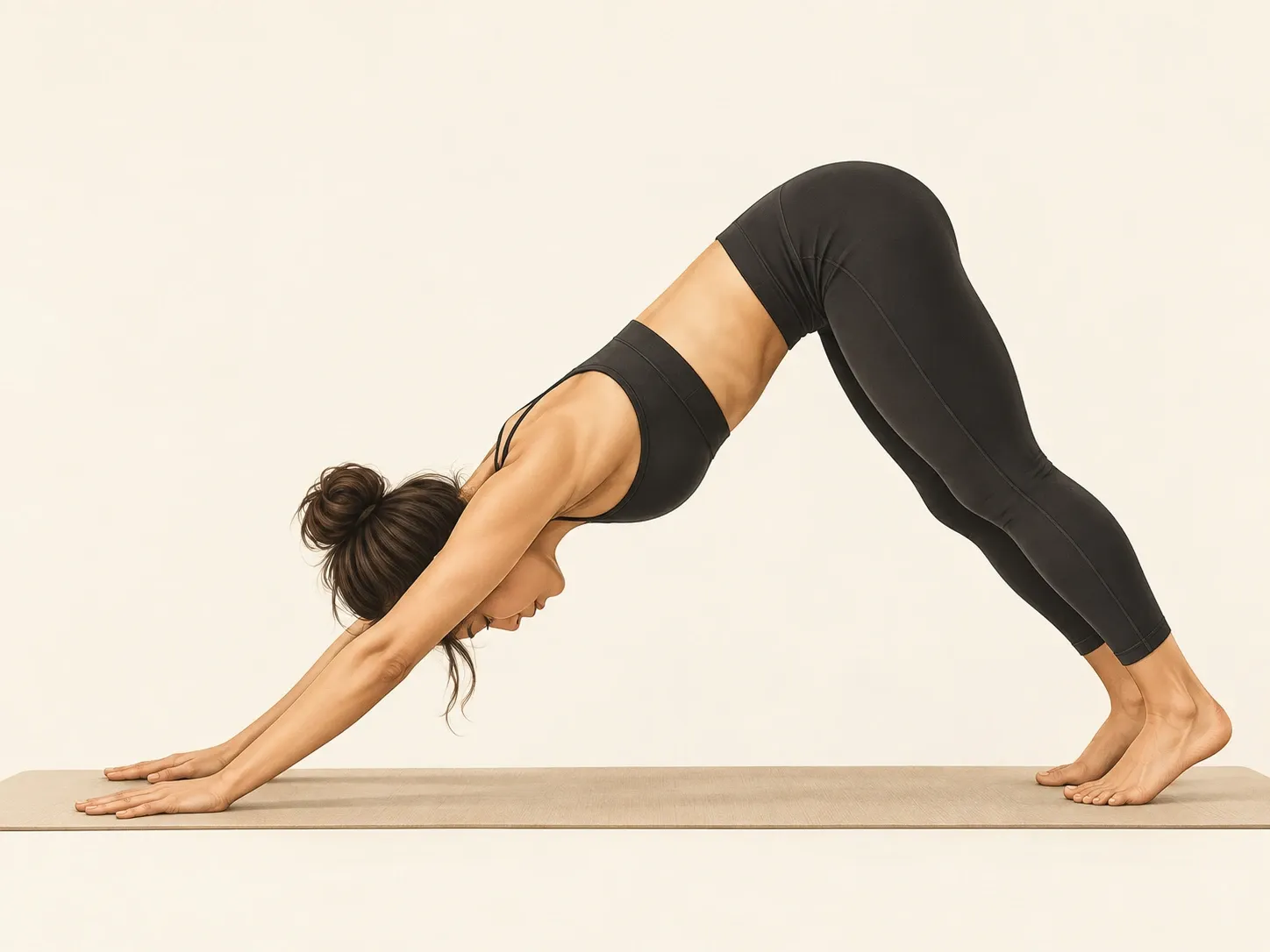
An upside-down V shape that gently lengthens the back and the backs of the legs while your weight is shared between hands and feet.
Also known as: Down Dog, Downward Dog, Adho Mukha Svanasana
At a glance
- Level
- Beginner
- Type
- Standing poses, Inversions
- Body focus
- Hamstrings, Shoulders, Spine
- You will need
- Mat
- How long
- 3–5 slow breaths to begin with. Stay longer only if it feels comfortable.
How to practise
Start here: Come onto your hands and knees, with your hands a little in front of your shoulders and your knees under your hips.
- Spread your fingers comfortably wide and press the whole of each palm into the mat.
- Curl your toes under so the balls of your feet rest on the mat.
- As you breathe out, lift your knees away from the mat and send your hips up and back.
- Keep your knees softly bent at first, so your back can stay long rather than rounded.
- Let your head hang between your upper arms, with your neck relaxed and your gaze towards your knees.
- If it feels comfortable, let your heels sink a little towards the mat. They do not need to touch it.
- Stay for a few slow breaths, keeping your weight shared evenly between your hands and feet.
Breath: Breathe in and feel your spine grow long. Breathe out and let your shoulders soften away from your ears.
Coming out: Bend your knees, lower them gently to the mat, and sit back towards your heels to rest for a few breaths.
Benefits
- Stretches the backs of the legs and the calves
- Invites length through the spine
- Builds steady strength in the arms and shoulders
- Offers a familiar place to pause and breathe between other poses
Common mistakes
-
Straightening the legs even though the back rounds
Try instead: Bend your knees as much as you need. A long back matters more here than straight legs.
-
Letting the shoulders creep up towards the ears
Try instead: Press the mat away with your hands and let your shoulder blades widen across your back.
-
Letting the weight sink into the heels of the hands
Try instead: Press through your fingertips and the base of each finger too, so the load is spread across the whole hand.
-
Holding the breath
Try instead: Keep the breath slow and easy. If you cannot breathe comfortably, ease off or come down and rest.
Make it easier
- Keep your knees bent the whole time. This is a complete version of the pose, not a lesser one.
- Place your hands on the seat of a sturdy chair set against a wall, then walk your feet back until your body makes a gentle upside-down L shape.
- Take shorter stays of two or three breaths, resting on your knees in between.
Cautions
- If your wrists, shoulders or the backs of your legs feel strained, bend your knees more, try the chair version, or rest.
- Come down straight away if you feel dizzy, light-headed, or any pressure in your head, eyes or ears.
- Move into and out of the pose slowly, especially if you are not used to having your head lower than your heart.
- This pose puts weight on your hands. If your wrists are sore or injured, choose a gentler option or leave it out.
- Poses with the head below the heart may not suit people with high or low blood pressure, glaucoma, or a tendency to feel dizzy. Check with a health professional first.
Stop if anything hurts. For more, read our health disclaimer.
About this pose
Many people meet Downward-Facing Dog in one of their first classes, often as a pause between other movements.
It can feel quite different from one day to the next: stiffer in the morning, easier after a walk. There is no finished version to reach. Let the shape meet you where you are today.